

More Buyers. More Opportunities. More Closings: The Non-QM Advantage
Non-QM Mortgages for Real Estate Agents: How to Create More Buyer Opportunities
t is frustrating to watch a motivated buyer lose confidence because a bank, online lender, or mortgage professional considered only one part of the financial picture. Your client may have a successful business, strong deposits, substantial assets, valuable investment experience, or a well-documented recovery after a credit event. Yet a traditional mortgage formula may not recognize the complete story.
This guide is designed to help real estate agents recognize those opportunities earlier, use simple and responsible language, and know when to bring in Steve McNeal at First Capital Mortgage Inc. You do not need to become a non-QM underwriter. You need a trained eye for the moment when a buyer deserves a thoughtful second look.
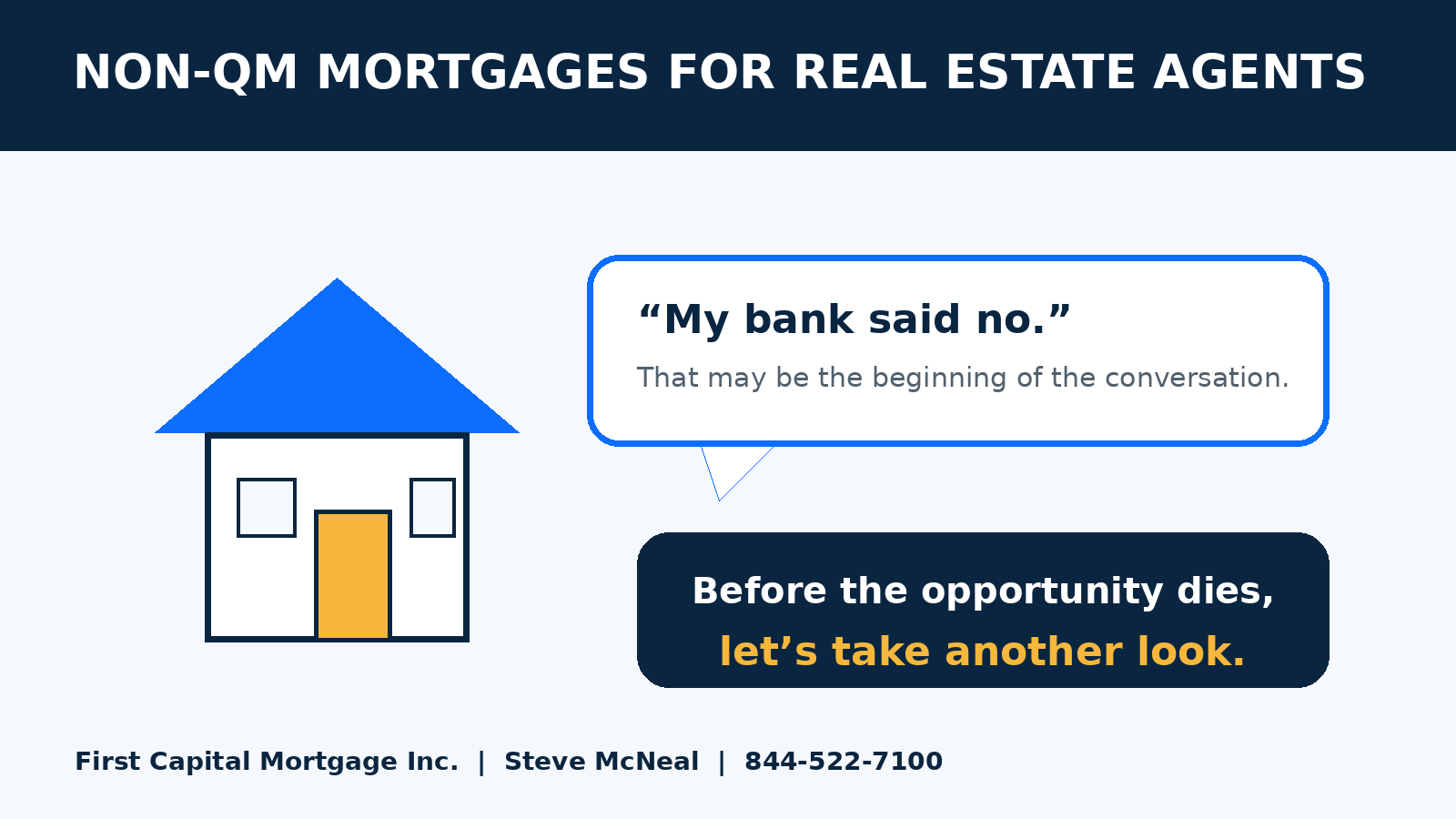
If the thought crosses your mind, "I do not think this buyer will qualify," let your next thought be, "Let's take another look."
What Is a Non-QM Mortgage?
Non-QM means a mortgage that does not meet the legal definition of a Qualified Mortgage, or QM. It does not mean unregulated, undocumented, or automatically risky. Lenders still evaluate whether the borrower and the transaction meet the program's requirements, and ability-to-repay rules apply to many consumer-purpose mortgages.
Qualified Mortgages follow specific federal standards involving features, pricing, points and fees, and the consideration of income, assets, and debts. Non-QM programs can provide additional flexibility for qualified borrowers whose income, assets, property cash flow, credit history, or documentation do not fit the traditional agency approach.
For an agent, the practical explanation is much simpler:
"Non-QM mortgages are flexible financing options for qualified buyers who may have a strong financial story but do not fit traditional agency guidelines."
Loan availability and terms vary by lender, state, occupancy, property type, documentation, credit, reserves, and other factors. The goal is never to promise approval. The goal is to create an informed second review before a legitimate opportunity is lost.
Why Non-QM Is a Business Growth Strategy for Agents
Non-QM is often described as another loan product. That description is too small. For a real estate professional, it can become a client-service and referral strategy.
When you identify a buyer who is being overlooked and connect that person with a mortgage professional who understands alternative documentation, you provide value before the property search becomes urgent. You may help restore the buyer's confidence, create a realistic plan, and convert an uncertain prospect into an offer-ready client.
The result can be:
- More productive conversations with business owners, investors, 1099 earners, and gig workers.
- More opportunities to rescue transactions before financing problems become contract problems.
- More reasons for clients and referral partners to remember you as the agent who looks for solutions.
- More qualified buyers who can confidently write offers and close on time.
The key is timing. Call before the opportunity dies. Steve at 844-522-7100. Once the buyer disengages, chooses another agent, or assumes homeownership is impossible, rebuilding momentum becomes much harder.
The Buyers Who May Deserve a Second Look
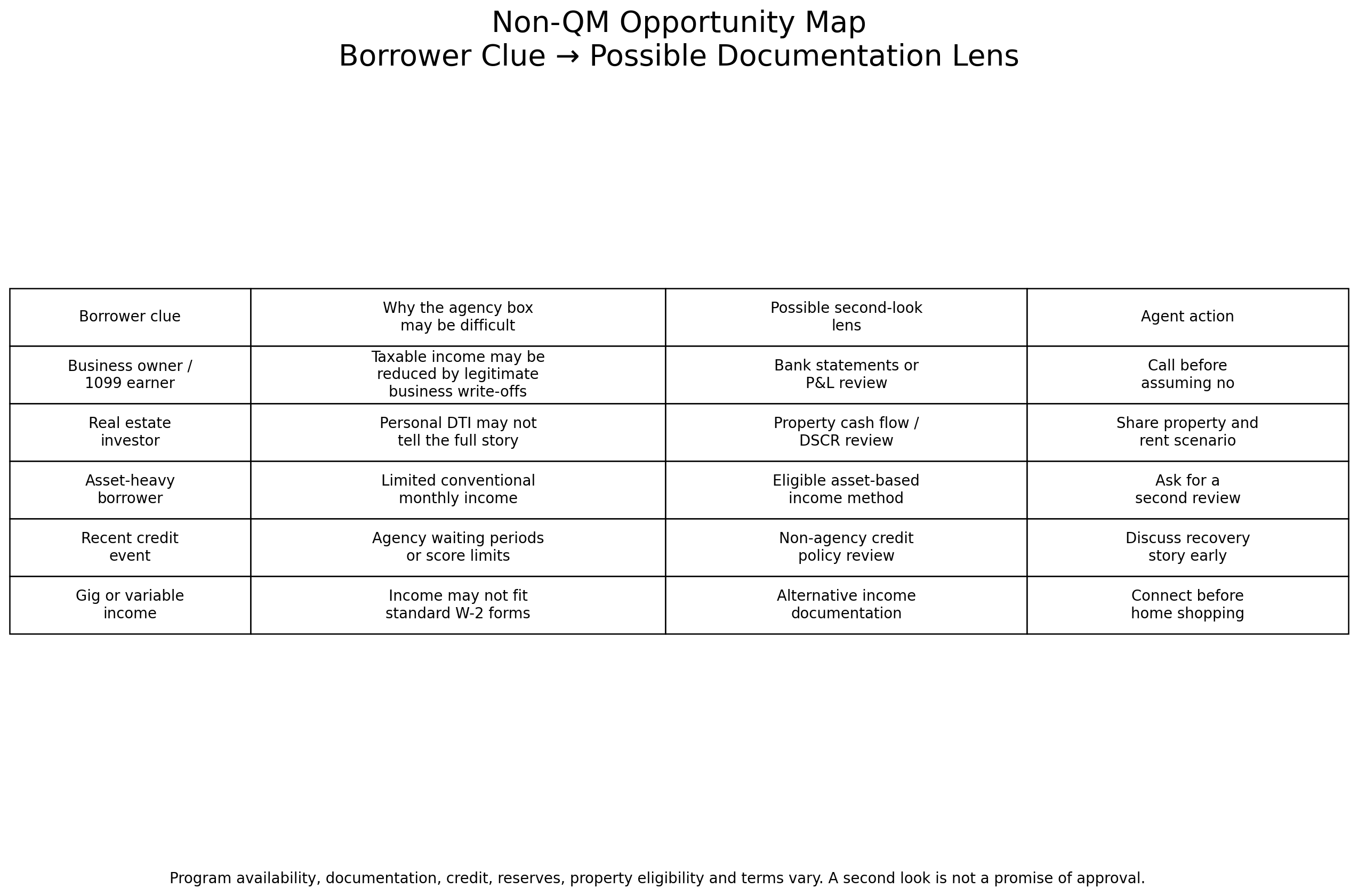
1. Self-Employed Business Owners
A business owner may have strong deposits, healthy cash flow, and years of successful operations. At the same time, legitimate tax deductions may reduce the net income shown on tax returns. Traditional underwriting may not fully capture the way the business produces income.
Depending on the program and facts, a lender may evaluate business or personal bank statements, a profit-and-loss statement, or another eligible method of documenting income. The borrower still needs to meet the chosen lender's credit, asset, reserve, property, and documentation requirements.
2. Real Estate Investors
An experienced investor may own several properties and understand rental real estate very well. However, personal debt-to-income calculations can become complicated as the portfolio grows.
For an eligible investment-property transaction, a DSCR program may focus more heavily on the property's qualifying rental income compared with the proposed housing expense. That can provide a more relevant lens than looking only at the investor's W-2 income or personal DTI.
3. Asset-Heavy Borrowers
Some buyers have substantial liquidity, retirement assets, or investment accounts but limited conventional monthly income. In appropriate cases, certain programs may allow an eligible asset-based income calculation. The exact method, eligible account types, documentation, reserves, and asset treatment vary significantly.
4. Borrowers Recovering from a Credit Event
A recent bankruptcy, foreclosure, short sale, late mortgage payment, or other credit event can create waiting periods or restrictions under traditional programs. A borrower may nevertheless have a meaningful recovery story supported by re-established credit, stable income, reserves, and responsible financial behavior.
Non-QM guidelines may provide a path in some circumstances, but pricing, down payment, reserves, and documentation may be more demanding. A careful review is essential.
5. 1099 Earners, Freelancers, and Gig Workers
Modern income does not always arrive through a predictable W-2 paycheck. Consultants, real estate professionals, contractors, creators, drivers, and other independent earners may have variable income patterns that require a more specialized analysis.
These clients are not automatically unqualified. They may simply need the right documentation strategy and the right lender.
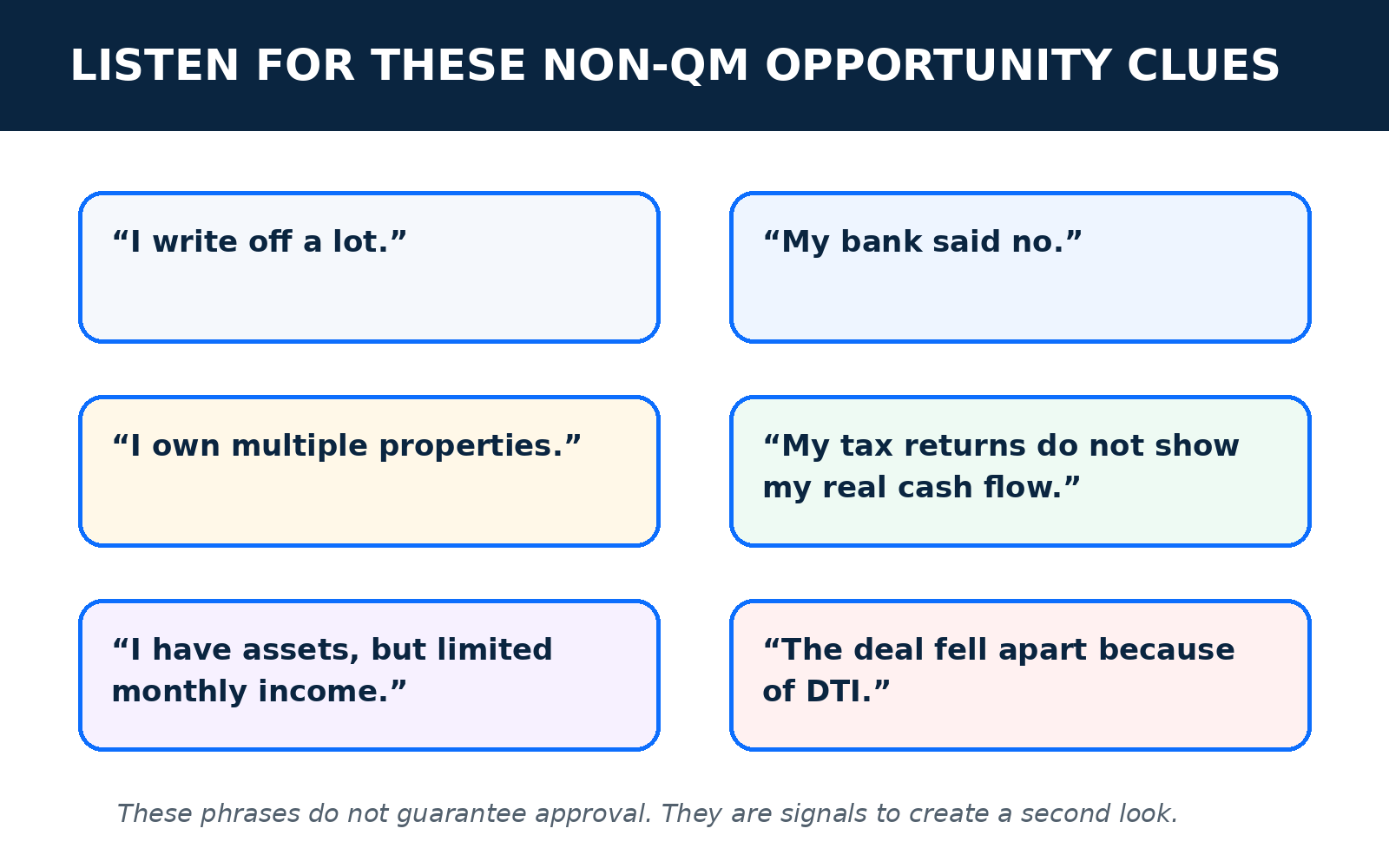
Listen for These Trigger Phrases
You do not need to diagnose the loan. Listen for language that tells you a different mortgage lens may be useful:
- "I write off a lot."
- "My bank said no."
- "I own multiple properties."
- "My tax returns do not show my real cash flow."
- "I have assets, but not much monthly income."
- "I had a recent credit event, but things are much better now."
- "I am self-employed, paid on a 1099, or work in the gig economy."
- "The deal fell apart because of the debt-to-income ratio."
These are not promises that a non-QM loan will work. They are signals that the buyer may need a second look before anyone concludes that homeownership is unavailable.
How to Explain Non-QM in Under 60 Seconds
Most referral conversations do not need a five-minute product explanation. Use language that is clear, helpful, and careful not to overpromise:
"Think of Steve McNeal at First Capital Mortgage Inc. as a resource for buyers who may not fit traditional financing but still have a strong financial story."
"He works with options for business owners, investors, asset-heavy borrowers, and clients who may need alternative income documentation."
"Before we let the opportunity go, let's ask Steve to take another look."
That explanation is simple, accurate, and client-centered. It does not quote a rate, promise eligibility, or require you to understand the underwriting details.
What Questions Can an Agent Ask?
Your goal is to understand the situation well enough to create a warm handoff, not to conduct a mortgage application. Helpful questions include:
- "How do you currently earn most of your income?"
- "Did the lender explain what prevented the approval?"
- "Do your tax returns reflect the cash flow you actually use to run your household?"
- "Do you own rental properties or other real estate?"
- "Would you describe yourself as having stronger assets than monthly income?"
- "Has your financial situation improved since the credit event?"
- "Would you be open to a second mortgage review before you change your homeownership plans?"
Avoid making underwriting judgments, requesting sensitive documents yourself, or promising that a particular program will be available. Let the licensed mortgage professional handle the detailed financial review and required disclosures.
When Should You Call Steve?
Before the client stops looking. Before the offer is written. Before a financing problem becomes a contract problem.
The best time to connect is when:
- A buyer says a bank or previous lender denied the application.
- A self-employed client worries that tax deductions will prevent qualification.
- An investor wants to purchase another rental property.
- A buyer has significant assets but limited conventional income.
- A borrower mentions a recent credit event and a strong recovery.
- A pre-approval was reduced or withdrawn because of income or DTI calculations.
- You simply feel uncertain about whether the buyer will qualify.
You are not interrupting the process. You are protecting the opportunity.
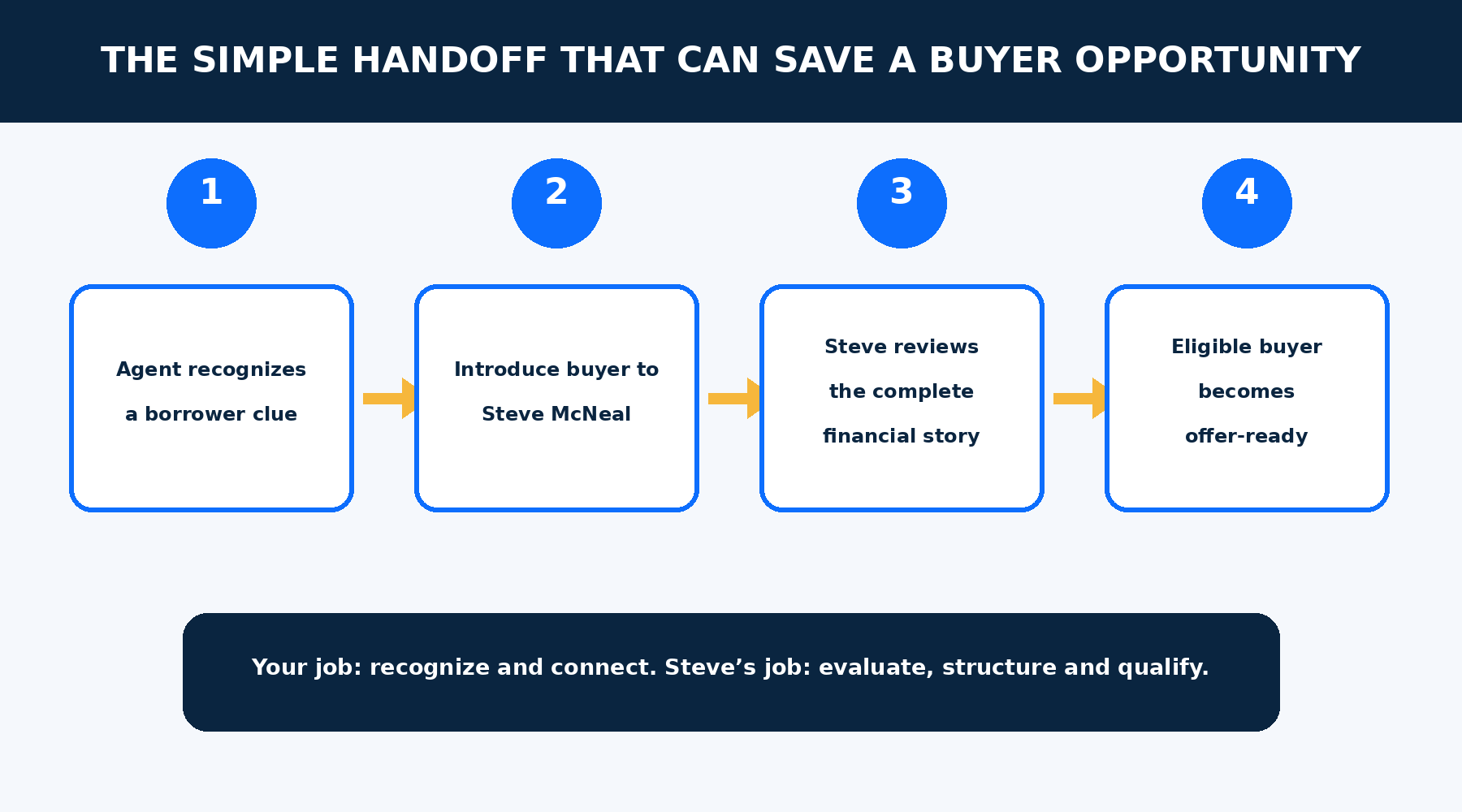
A Simple Introduction You Can Send by Text or Email
Steve, I would like to introduce you to [Buyer Name].
[Buyer Name] is interested in purchasing a home and may have a financial situation that does not fit traditional mortgage documentation. I told them you are experienced in reviewing self-employed, investor, asset-based, and other non-QM scenarios.
Please connect with each other and determine whether there is an eligible path and what steps would be needed to become offer-ready.
Thank you both.
Three Important Expectations to Set
A second look is not a guaranteed approval.
Every loan is subject to lender guidelines, documentation, property eligibility, appraisal, title, credit, reserves, income or asset analysis, and final underwriting approval.
Flexibility may come with different costs and requirements.
Compared with agency financing, a non-QM option may involve a higher interest rate, a larger down payment, more reserves, different fees, or other program-specific requirements. The right comparison considers the borrower's goals, timeline, alternatives, and total financial benefit.
The first solution may be a plan rather than an immediate loan.
Sometimes the review identifies a program that works now. Other times, it creates a roadmap involving credit improvement, additional reserves, updated documentation, debt reduction, or more time in business. Either outcome gives the buyer clarity and keeps you positioned as the trusted real estate advisor.
Non-QM Is About the Complete Story
A borrower's tax return, credit score, or DTI ratio is important, but it may not tell the complete story. Non-QM lending is often about whether the borrower has a sufficiently strong and documentable financial profile, whether the property and transaction are eligible, and whether an appropriate lender has a program that fits.
Do not try to become the non-QM expert. Be the expert at what you do: finding the right home, guiding the client, negotiating the transaction, and coordinating the professionals who help the buyer succeed.
Your competitive advantage is not knowing every guideline. It is recognizing when a buyer is worth a second look and knowing exactly whom to call.
Why This Matters Beyond the Transaction
When you help an unsure buyer find a responsible path to homeownership, you are adding value to that person's future, not merely creating another sale. Homeownership can support stability, lifestyle choices, long-term planning, and the opportunity to build equity over time.
That is why an early introduction matters. Miss the opportunity at the beginning, and you may become one of several agents the buyer speaks with on the long road to homeownership. Create the right connection now, and you become the professional who helped turn uncertainty into a plan.
For more perspective on the long-term meaning of homeownership, read The Best Christmas Gift You Can Give Your Family: One That Lasts for Generations.
Frequently Asked Questions
Is a non-QM mortgage the same as a subprime loan?
No. "Non-QM" describes a mortgage that does not meet the legal definition of a Qualified Mortgage. Non-QM lenders still use underwriting guidelines and evaluate the borrower, documentation, property, and ability to repay when applicable. Credit, down payment, reserves, and pricing vary by program.
Can a self-employed borrower qualify without tax returns?
Some programs may allow eligible bank statements, profit-and-loss documentation, or other approved methods instead of traditional tax-return income. Requirements vary, and the borrower must still meet the lender's complete guidelines.
What is a DSCR loan?
A DSCR loan is generally designed for eligible investment properties and evaluates the relationship between qualifying property income and the proposed property expense. It is not the right program for every investor or property.
Should a real estate agent quote non-QM rates or terms?
No. The agent should identify the opportunity, make the introduction, and let the licensed mortgage professional review the scenario, explain available options, and provide required disclosures.
When is the best time to refer a possible non-QM buyer?
As early as possible. A proactive review gives the buyer time to gather documents, compare options, address weaknesses, and become properly pre-approved before writing an offer.
Let's Create the Second Look
Anytime you hear a client say they write off a lot, own multiple properties, were denied by a bank, have substantial assets but limited income, or had a recent credit event, send the scenario to me before assuming the buyer cannot qualify.
I will listen to the complete story, evaluate available traditional and non-QM options, and explain the next best step without overpromising. When there is an eligible path, we will work together to invigorate the buyer, complete a meaningful pre-approval, and position you to write a stronger offer that can close successfully.
Ready to Create More Buyer Opportunities?
Whether you have a buyer who was denied, a self-employed client with significant tax write-offs, an investor building a portfolio, or someone whose financial story does not fit the traditional agency box, I am here to help you determine the next right step.
You do not need to know every program or underwriting guideline. You just need to recognize when it is time to create a second look.
Schedule a Conversation
Talk with Steve about the buyer's goals, financial story, and possible mortgage options.
Start Pre-Approval
Help your buyer begin securely online so we can evaluate the complete scenario.
Call or Text
Prefer a direct conversation? Reach Steve using the appropriate number below.
Call:
844-522-7100
Text:
209-522-7100
Email: Steve@FirstCapitalMortgageInc.com
One Small Favor
If any of your friends, family, or co-workers are looking to buy, sell, or refinance, can I count on you to introduce us via text or email?
That introduction means a lot. It can also help someone you care about receive a thoughtful second mortgage review before they give up on their homeownership plans.
Additional Resources
- Self-Employed Home Loan Solutions: Bank Statements, P&L and DSCR
- Mortgage Home Purchase Loans Made Simple
- The Best Christmas Gift You Can Give Your Family
- Consumer Financial Protection Bureau: What Is a Qualified Mortgage?
- Consumer Financial Protection Bureau: Ability-to-Repay and Qualified Mortgage Resources
Important: This article is for general educational and real estate referral purposes. It is not a commitment to lend, a guarantee of approval, or a quote of rates or terms. Mortgage programs, guidelines, pricing, documentation, property eligibility, down payment and reserve requirements vary by lender and borrower circumstances and may change without notice. All loans are subject to application, credit review, verification, appraisal when required, underwriting and final approval. Equal Housing Opportunity.