

Complex Home Financing Solutions: Why Experienced Mortgage Strategy Matters in 2026
This article is the overview for a seven-part series about home financing situations that deserve more than a routine rate quote.
When income, debt, savings, home equity, retirement, or a major life change complicates a mortgage decision, it is understandable to feel frustrated or uncertain. You may have strong credit, dependable income, valuable assets, or years of home equity and still receive an answer that does not reflect your complete financial story.
That does not always mean there is no responsible path forward. It may mean the situation deserves a more experienced review.
What Are Complex Mortgage Solutions?
Complex mortgage solutions are financing strategies for borrowers whose income, debt, property, home equity, or future plans do not fit neatly into a routine lender checklist. An experienced mortgage broker can compare lenders, documentation methods, first and second mortgages, home equity choices, and long-term costs before recommending a direction.
The objective is not merely to obtain an approval. The objective is to identify a structure that fits your goals, can be supported through underwriting, and makes sense beyond the closing date.

Complex Mortgage Decisions Deserve Experienced Advice
I entered the mortgage industry in 1986 and have been a California real estate broker since 1993. During that time, I have helped borrowers navigate changing interest-rate environments, housing cycles, underwriting changes, business ownership, retirement transitions, difficult documentation, and transactions that required more than a standard answer.
That experience matters when a borrower has self-employed income, several properties, high consumer debt, a favorable first mortgage they would prefer to preserve, substantial assets, limited taxable income, retirement concerns, or a time-sensitive need to move.
A complex situation should not be reduced to an online calculator or the limited loan menu offered by one institution. The mortgage must fit the borrower, anticipate underwriting questions, support the larger financial goal, and have a realistic path to closing on time.
When a mortgage decision affects your monthly cash flow, home equity, retirement, or ability to move, average guidance may not be enough.
The Difference Between a Loan Quote and a Mortgage Strategy Review
A rate and payment are important, but they are not the entire decision. Closing costs, cash reserves, mortgage insurance, income documentation, repayment period, prepayment provisions, existing mortgage terms, and future plans can materially change which option makes sense.
| Area Reviewed | Basic Loan Quote | Experienced Mortgage Strategy Review |
|---|---|---|
| Primary question | What rate and payment can be offered? | What are you trying to accomplish, and which structure responsibly supports that goal? |
| Income | Does the income fit one standard calculation? | Should tax returns, bank statements, 1099s, assets, rental income, or another eligible method be evaluated? |
| Cash needed | What is the minimum down payment? | How much cash should remain available for reserves, repairs, business needs, retirement, and future opportunities? |
| Consumer debt | Does the debt-to-income ratio qualify? | Would restructuring debt improve qualification and cash flow, and would the long-term cost and risk be acceptable? |
| Home equity | How much cash can be withdrawn? | Should the existing first mortgage be preserved, supplemented, replaced, or left alone? |
| Retirement | Does current income qualify? | How will the payment, equity, reserves, and housing plan work after retirement? |
| Life changes | Can the borrower purchase another home? | What are the costs and benefits of selling, retaining, renting, bridging, or purchasing before selling? |
| Final objective | Approve and fund a loan. | Structure the appropriate loan, anticipate obstacles, protect the client’s goals, and close successfully. |
Seven Home Financing Challenges That May Require a Deeper Review
These challenges are common, but the best answer is rarely identical from one household to another. The purpose of this guide is to help you recognize when a more complete review may uncover responsible choices that a routine application could miss.
1
Affordability Pressure
Home price, interest rate, property taxes, insurance, mortgage insurance, HOA dues, repairs, and everyday living expenses all affect affordability.
The goal should not be to stretch a household to its maximum approval. The goal is to identify a comfortable payment and build the strongest available structure around it.
2
Self-Employed or Nontraditional Income
A successful business owner may have dependable cash flow while reporting lower taxable income after legitimate business deductions.
Depending on the complete scenario, conventional calculations, bank statements, profit-and-loss statements, 1099 income, asset utilization, DSCR, or other eligible documentation may deserve review.
3
Limited Down Payment Funds
Many people still believe a 20 percent down payment is always required. It is not.
Eligible VA and USDA borrowers may have no-down-payment choices. FHA, conventional, state, local, and institutional assistance programs may also reduce the cash required for an eligible purchase.
4
High Consumer Debt
Credit cards, personal loans, student loans, and vehicle payments can restrict mortgage qualification and create pressure on monthly cash flow.
A refinance or home equity strategy may help in some situations, but the comparison must address closing costs, repayment time, risk, and the consequences of converting unsecured debt into debt secured by the home.
5
Home Equity That Feels Trapped
A homeowner may have considerable equity and still feel financially restricted.
The choices might include a HELOC, fixed second mortgage, cash-out refinance, reverse mortgage, sale, downsizing, or no new loan. Preserving a favorable existing mortgage can be an important part of the analysis.
6
Retirement and Future Income
Retirement mortgage planning may include paying off a loan, keeping affordable financing, accessing equity, downsizing, moving closer to family, or reviewing a reverse mortgage.
The responsible choice depends on income, reserves, equity, health considerations, family plans, and the lifestyle the homeowner wants to protect.
7
A Life Event That Creates a Need to Move
A job change, marriage, divorce, growing family, retirement, health concern, or desire to live closer to loved ones can create a need to move even when the homeowner has an attractive mortgage rate.
A low rate is valuable, but it should not automatically control a major family decision. The financial cost of moving should be compared with the personal and financial cost of staying.
+
Several Challenges at Once
Many borrowers are not dealing with one isolated issue. They may be self-employed, carrying consumer debt, trying to preserve cash, and purchasing before selling another home.
That is when sequencing, lender selection, documentation, reserves, and advance planning become especially important.
Income and Assets May Tell a Different Story Than a Standard Application
One of the most common reasons a borrower needs a deeper review is that a W-2 or traditional taxable-income calculation does not capture the full financial picture.
A bank normally reviews the programs that institution offers. A mortgage broker may be able to compare several lenders, traditional programs, non-QM options, documentation methods, and property-specific solutions. This does not guarantee approval, but it can create a more complete and responsible evaluation.
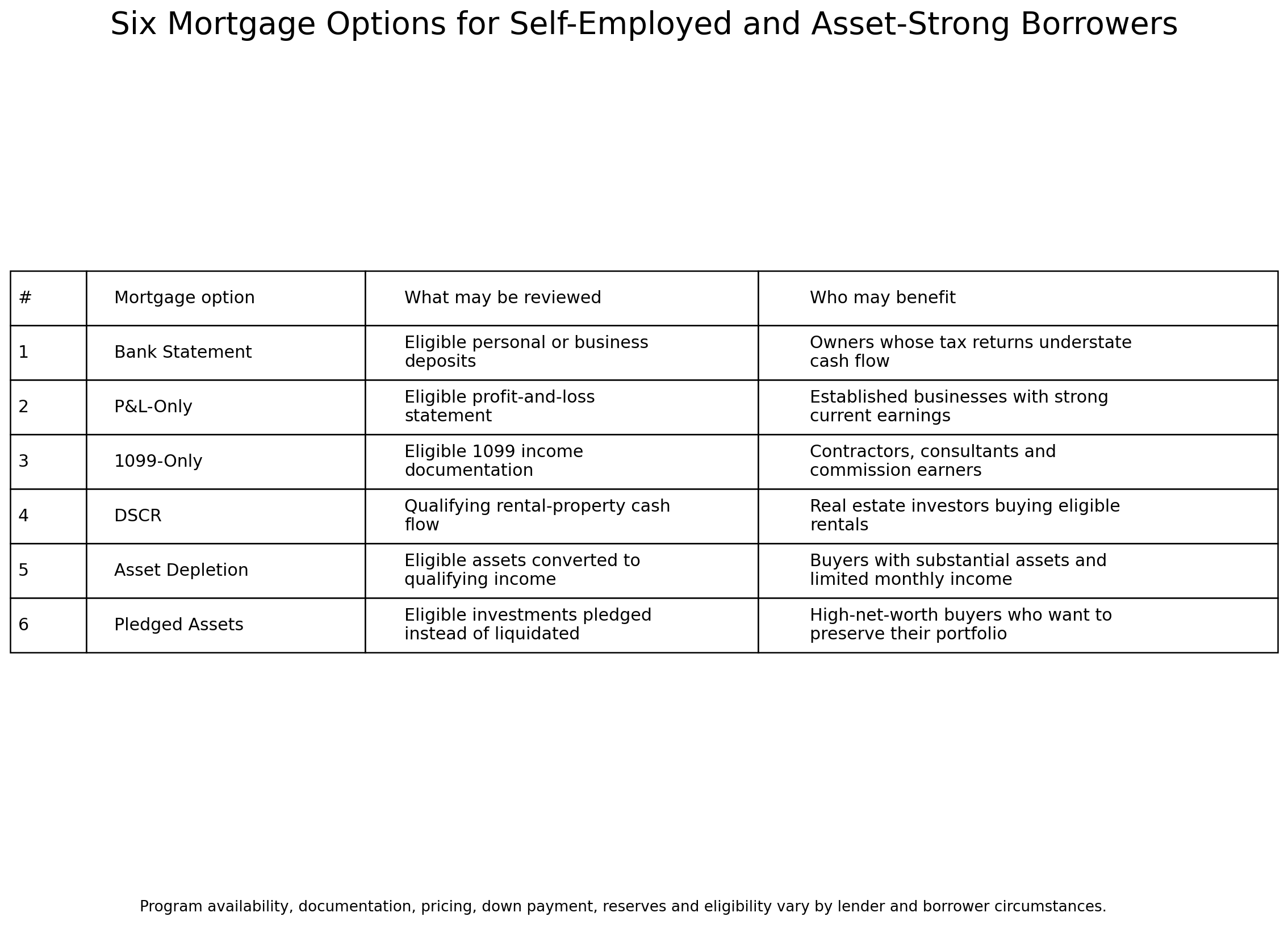
Read the complete guide to six self-employed mortgage options.
How an Experienced Review Changes the Conversation
Representative Planning Example 1
A Profitable Business Owner Whose Tax Return Shows Less Income
Imagine a self-employed consultant with consistent business deposits, strong credit, cash reserves, and several years in business. The first lender reviews only the net taxable income and concludes that the requested payment does not fit.
A deeper review would ask additional questions:
- Were all eligible conventional income adjustments and add-backs calculated correctly?
- Would one or two years of tax returns produce a different eligible result?
- Could personal or business bank statements provide a lender-approved view of cash flow?
- Would a profit-and-loss, 1099, asset-utilization, or another eligible documentation method better represent the borrower?
- How would the interest rate, down payment, reserves, closing costs, and prepayment terms compare?
The correct outcome might still be a conventional mortgage. It might be an alternative-documentation loan. It might also be a plan to improve documentation before purchasing. The value comes from completing the comparison before assuming the borrower has no option.
This is an illustrative scenario, not a representation of a specific client, approval, rate, or available program.
Representative Planning Example 2
A Homeowner With a Low-Rate First Mortgage and High Consumer Debt
Consider a homeowner with a hypothetical $650,000 home, a $290,000 low-rate first mortgage, and $68,000 in credit cards, personal loans, or vehicle debt. The consumer debt is creating significant monthly pressure.
The question is not simply, "Can the homeowner take cash out?" The review should compare at least three directions:
| Possible Direction | Potential Benefit | Important Tradeoff |
|---|---|---|
| Leave the mortgage and debts unchanged | Preserves the existing first mortgage and avoids new closing costs. | High consumer-debt payments and interest may continue restricting cash flow. |
| Add a fixed second mortgage or HELOC | May preserve the existing first mortgage while consolidating selected debts. | Creates another payment, uses home equity, and may involve a higher or variable rate. |
| Replace everything with a new first mortgage | May produce one consolidated payment and simplify monthly obligations. | Reprices the entire first-mortgage balance, resets repayment timing, and uses home equity. |
A responsible comparison should show the new monthly payments, closing costs, total balances, repayment terms, break-even period, interest exposure, and what happens if the household begins using the paid-off credit cards again.
All figures are hypothetical and are included only to demonstrate the review process. They are not a loan quote or recommendation.
Home Equity Is Valuable, but the Structure Matters
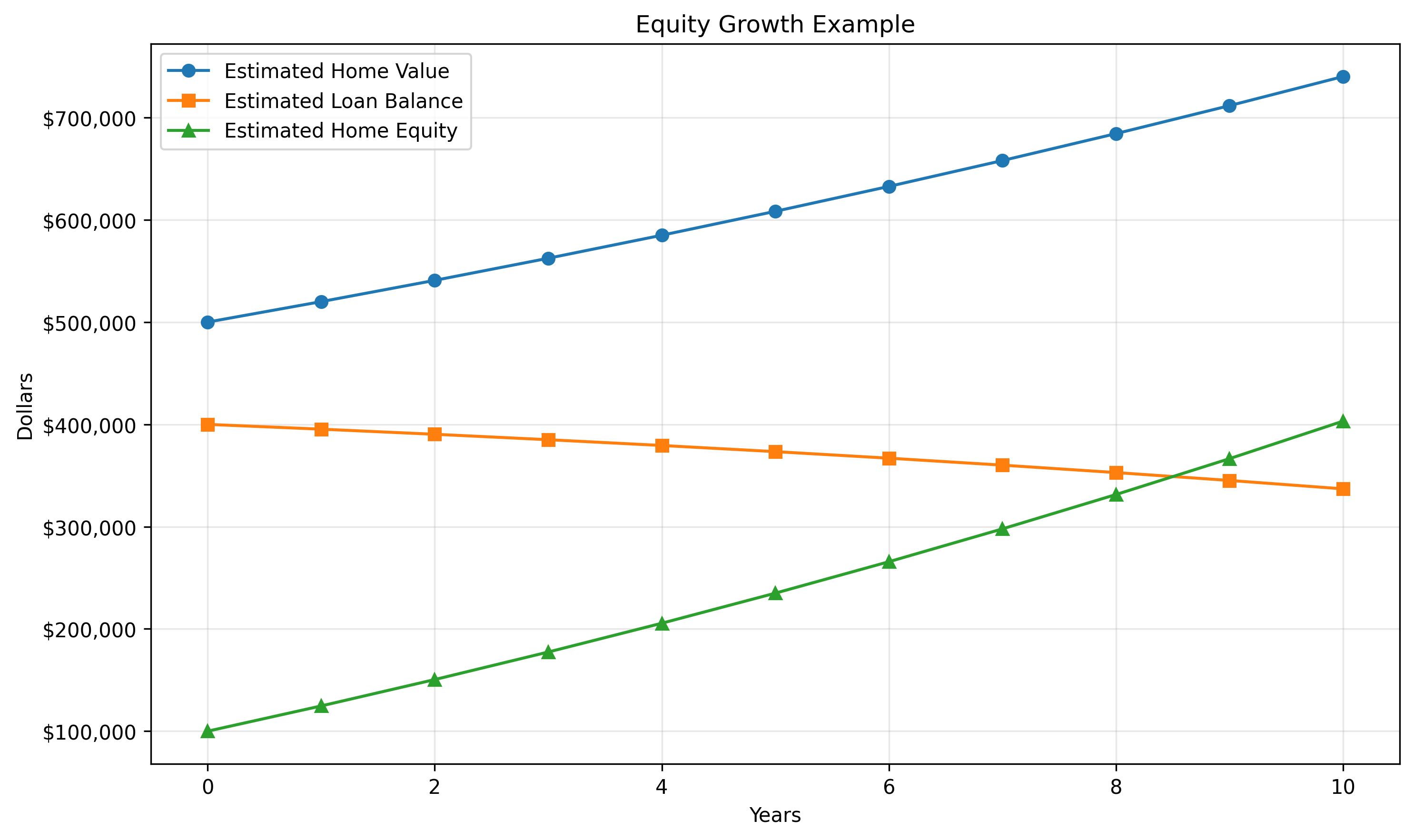
Accessing home equity should not begin with the question, "How much can I borrow?" The more important questions are why the funds are needed, how the payment will fit, what happens to the existing mortgage, and how the decision affects future equity and financial flexibility.

A homeowner with a low-rate first mortgage may benefit from preserving that loan and using a smaller second mortgage. Another homeowner may achieve a more suitable result by consolidating obligations into a new first mortgage. An eligible older homeowner may want to compare a traditional refinance, a home equity loan, a HELOC, downsizing, and a reverse mortgage.
The numbers and personal goals should be reviewed together. Looking at one rate or one payment without understanding the complete outcome can lead to an expensive decision.
Complex Mortgage Planning in California, Nevada, and Tennessee
Mortgage guidelines are largely driven by the selected loan program and lender, but the property market, housing costs, insurance, taxes, relocation plans, rural eligibility, and local transaction practices can affect the strategy.
Local Knowledge Supports Better Questions
California
Higher purchase prices, insurance costs, property taxes, business ownership, and complex income can make documentation, reserves, loan limits, and payment planning especially important.
Nevada
Relocation, retirement, second homes, investment properties, and borrowers moving between California and Northern Nevada may create timing and qualification questions that should be addressed early.
Tennessee
Relocation, affordability, rural-property eligibility, military benefits, and varied property types may make conventional, FHA, VA, USDA, and alternative-income comparisons worthwhile.
First Capital Mortgage Inc. works with eligible borrowers in California, Nevada, and Tennessee, subject to applicable licensing, lender coverage, program availability, borrower qualifications, and property eligibility.
What I Review Before Recommending a Direction
A meaningful mortgage strategy review begins with what you want your financing to accomplish. From there, I review the financial pieces that could support or restrict the available choices.
- Your immediate goal and why it matters
- Your comfortable monthly payment
- Traditional and alternative income documentation
- Cash available for down payment and closing costs
- Emergency, business, and post-closing reserves
- Consumer debt and monthly cash-flow pressure
- Your current mortgage rate, balance, and remaining term
- Available home equity and the cost of accessing it
- Property type, occupancy, location, and intended use
- Expected employment, business, retirement, or family changes
- Closing costs and long-term repayment consequences
- Potential underwriting issues that should be addressed early
Sometimes the Best Outcome Is a Plan, Not an Immediate Loan
You do not need perfect credit, perfectly organized documents, or complete knowledge of mortgage programs before asking for help.
Sometimes the review leads to an immediate pre-approval. Sometimes it identifies a more suitable loan structure. Sometimes the most valuable outcome is a clear three-month, six-month, or twelve-month plan that improves credit, reduces a particular debt, strengthens reserves, documents income more effectively, or prepares for a future purchase.
Professional guidance does not mean forcing every client into a transaction. It means helping you understand the choices, the tradeoffs, and the next responsible step.

Coming Up in This Complex Mortgage Solutions Series
This overview introduces seven focused topics that will be explored in greater detail:
- Improving affordability without stretching the household budget
- Qualifying with self-employed, variable, or nontraditional income
- Low down payment and down payment assistance strategies
- Using mortgage planning to address high consumer debt
- Comparing a HELOC, fixed second mortgage, and cash-out refinance
- Connecting home equity and mortgage choices to retirement planning
- Moving when you already have a favorable mortgage rate
If your situation feels complicated, that does not mean there is no solution. It means your complete financial picture deserves an experienced review before a major decision is made.
Frequently Asked Questions About Complex Mortgage Solutions
What makes a mortgage situation complex?
A mortgage may become complex when the borrower has self-employed or variable income, several properties, high consumer debt, limited down-payment funds, significant assets, retirement income, a low-rate existing mortgage, unusual property characteristics, or several financial goals that must work together.
Can another mortgage broker help after my bank declined me?
Possibly. A bank normally reviews its own available programs and documentation rules. A mortgage broker may be able to compare several lenders and financing methods. A second review does not guarantee approval, but it may determine whether another eligible option or preparation plan exists.
Can self-employed borrowers qualify without relying entirely on tax returns?
Some eligible programs may use bank statements, 1099 income, a profit-and-loss statement, assets, rental-property cash flow, or other approved documentation. Requirements vary considerably by lender, program, borrower, property, and occupancy.
Is using home equity to consolidate debt a good idea?
It can improve cash flow in some situations, but it is not automatically the best decision. The review should compare closing costs, total debt, repayment time, monthly savings, the existing mortgage, future equity, and the risk of securing previously unsecured debt with the home.
Do I always need 20 percent down to purchase a home?
No. Depending on eligibility, conventional, FHA, VA, USDA, state, local, and institutional programs may permit a smaller down payment or provide assistance. The best option depends on the complete transaction and the funds needed after closing.
Should I refinance a low-rate mortgage to access equity?
Not automatically. A homeowner should compare leaving the current mortgage unchanged, adding a fixed second mortgage, using a HELOC, completing a cash-out refinance, selling, downsizing, or taking no action. Preserving a favorable first mortgage may be valuable, but the entire financial outcome should be reviewed.
What should I prepare before speaking with Steve?
Begin with your goal, estimated income, major debts, available cash or assets, current mortgage information, desired property, and any concern raised by a previous lender. You do not need a perfectly organized loan package before having an initial conversation.
Additional Mortgage Resources
- Six Mortgage Options for Self-Employed Borrowers
- First Capital Mortgage Home Purchase Options
- Mortgage Refinance and Home Equity Review
- Reverse Mortgage Information
- Financial Literacy for Homeowners: 2026 Action Plan
- HUD and FHA Mortgage Information
- Department of Veterans Affairs Home Loan Information
- USDA Rural Housing Programs
- Consumer Financial Protection Bureau Mortgage Resources
- NMLS Consumer Access
Ready to Review Your Mortgage Options?
You do not need to know which loan program fits before calling. Start by explaining what you want to accomplish, what has been getting in the way, and what a successful outcome would make possible for you or your family.
I will help you review the mortgage side of the decision, explain the available choices, identify important tradeoffs, and determine the next responsible step.
Schedule a Conversation
Choose a convenient time to discuss your purchase, refinance, home equity, retirement, or moving goals directly with Steve.
Start Pre-Approval
Begin securely online so we can review your income, assets, property, credit, and available mortgage options.
Was This Helpful?
Someone you know may be facing a mortgage challenge and may not realize that another responsible option or preparation plan could exist.
Call 844-522-7100
|
Text 209-522-7100
|
Email Steve@FirstCapitalMortgageInc.com
One Small Favor
If any of your friends, family, or co-workers are looking to buy, sell, or refinance, can I count on you to introduce us via text or email?
A simple introduction may help someone receive a thoughtful second review before giving up on a purchase, refinance, move, or important financial goal.
Make it a Successful Week!
Steve McNeal
Mortgage Broker and Loan Officer
First Capital Mortgage Inc.
844-522-7100
Steve@FirstCapitalMortgageInc.com
FirstCapitalMortgageInc.com
Important information: This article is provided for general educational purposes. It is not a commitment to lend, a guarantee of approval, financial advice, or a quote of interest rates or loan terms. Mortgage programs, pricing, documentation requirements, down-payment options, property eligibility, credit requirements, loan amounts, reserves, and underwriting standards vary by lender, investor, borrower, property, occupancy, and location and may change without notice.
Home equity loans, home equity lines of credit, cash-out refinances, and reverse mortgages create debt secured by the home and may reduce available equity. Converting unsecured obligations into mortgage debt may increase the risk to the home. Reverse mortgage borrowers must continue to satisfy applicable occupancy, property-maintenance, property-tax, homeowners-insurance, and other loan obligations.
First Capital Mortgage Inc. provides mortgage guidance, not legal, tax, accounting, investment, insurance, or estate-planning advice. Consult the appropriate qualified professionals before making decisions involving taxes, investments, retirement assets, business entities, insurance, title, trusts, or legal documents. All loans are subject to application, verification, credit review, appraisal when required, underwriting, and final approval. Equal Housing Opportunity.
“`