
Self-Employed and Ready to Buy a Home? Six Mortgage Options Your Bank May Not Offer
Self-employed mortgage options can help when your tax returns do not show the complete strength of your business or finances.
If you have built a successful business and then been told you do not show enough income to buy a home, that can feel frustrating and discouraging. You may have strong deposits, dependable cash flow, valuable assets, excellent credit, and years of responsible financial decisions. Yet the deductions that help you manage your tax obligation can make traditional mortgage qualification more difficult.
That does not necessarily mean you are unqualified. It may mean your income, assets, or investment experience need to be evaluated differently.
At First Capital Mortgage Inc., I help self-employed borrowers, business owners, independent contractors, investors, and asset-strong buyers explore both traditional and non-QM mortgage options. The goal is not to force your financial life into one standard formula. The goal is to understand the complete story and determine whether an eligible mortgage path exists.
Your tax return is important, but it may not be the only responsible way to document your ability to repay a mortgage.
Why Self-Employed Mortgage Qualification Can Feel So Difficult
Traditional mortgage underwriting often begins with taxable income reported on personal and business tax returns. That works well for many salaried borrowers. It can be less representative for entrepreneurs whose financial picture includes legitimate business expenses, depreciation, variable revenue, retained earnings, multiple entities, or income that does not arrive through a predictable paycheck.
For example, a borrower may:
- Deposit substantial revenue every month while reporting lower taxable income after business deductions.
- Receive income through 1099s rather than a W-2.
- Own several rental properties that complicate a traditional debt-to-income calculation.
- Have substantial stocks, bonds, mutual funds, cash, or other eligible assets but limited conventional monthly income.
- Need a mortgage professional who understands both agency and non-QM documentation strategies.
A responsible lender still has to evaluate the borrower, the property, the documentation, and the ability to repay when required. Non-QM does not mean "no qualification." It means the loan may use a different, lender-approved method to document a strong financial profile.
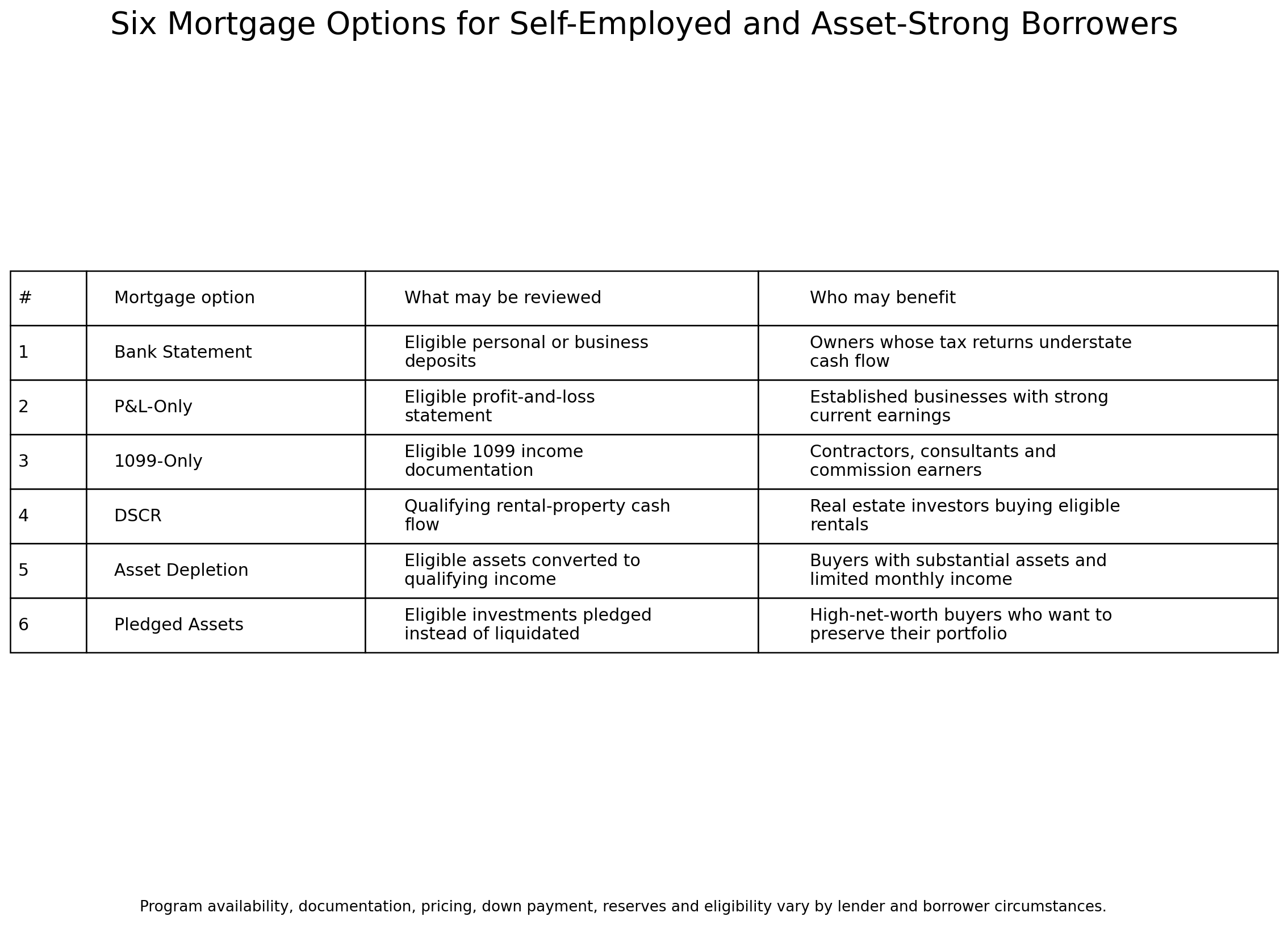
Six Self-Employed Mortgage Options That May Tell Your Story More Accurately
Not every option is available for every borrower, property, occupancy, or state. Your best strategy depends on the complete scenario. These are six common approaches worth reviewing.
1. Bank Statement Mortgages
A bank statement mortgage may use eligible deposits shown on personal or business bank statements instead of relying entirely on the net income shown on tax returns.
Depending on the program, the lender may review 12 or 24 months of statements, identify qualifying business revenue, exclude transfers and non-income deposits, and apply an appropriate business-expense factor. Some programs use personal statements, while others are designed around business statements.
This may be helpful for: business owners, consultants, real estate professionals, freelancers, gig workers, and other borrowers whose cash flow is stronger than their taxable net income suggests.
2. Profit-and-Loss-Only Mortgages
Certain programs may allow an eligible profit-and-loss statement to serve as the primary income document. Depending on the lender, the P&L may need to be prepared or verified by a CPA, enrolled agent, licensed tax preparer, or other qualified professional.
The lender will still evaluate the business history, current profitability, credit, assets, reserves, property, and overall risk profile. "P&L-only" does not mean that no supporting documentation is ever required.
This may be helpful for: established business owners with strong current earnings whose older tax returns no longer reflect present business performance.
3. 1099-Only Mortgages
Some independent contractors and commission-based professionals receive most of their income through Form 1099 rather than a W-2. An eligible 1099 program may evaluate one or more years of 1099 income, sometimes with evidence of current year-to-date earnings or deposits.
The exact expense treatment and documentation requirements vary. The important point is that being paid as an independent contractor does not automatically prevent mortgage qualification.
This may be helpful for: contractors, consultants, sales professionals, healthcare providers, drivers, creators, freelancers, and other independent earners.
4. DSCR Loans for Real Estate Investors
A debt-service coverage ratio, or DSCR, loan is generally designed for eligible investment properties. Instead of qualifying primarily through the investor's personal employment income, the lender evaluates the relationship between qualifying property income and the proposed property expense.
This can be particularly useful for self-employed investors who own multiple properties, take substantial deductions, or want to continue growing a rental portfolio without making every transaction depend on a traditional personal DTI calculation.
This may be helpful for: experienced and newer real estate investors purchasing eligible long-term rentals or other qualifying investment properties.
5. Asset Depletion or Asset Utilization Mortgages
Some borrowers have accumulated substantial assets but receive limited conventional monthly income. An asset-depletion or asset-utilization program may convert a portion of eligible assets into a calculated monthly income amount for mortgage qualification.
The borrower does not necessarily have to spend all those assets. The lender applies its own formula, eligible-asset rules, account ownership requirements, age or distribution considerations, and reserve standards.
This may be helpful for: retirees, entrepreneurs between business ventures, investors, executives, and other asset-strong borrowers whose monthly income does not fully represent their financial capacity.
6. Pledged Asset Mortgages: Purchase Without Liquidating the Full Portfolio
This strategy may allow an eligible high-net-worth borrower to buy a home while keeping more stocks, bonds, mutual funds, cash, or other approved market assets invested.
Call for details: the available structure, asset eligibility, required cash contribution, loan amount, portfolio valuation, and collateral requirements are highly program-specific.
In a traditional high-value home purchase, the borrower might be expected to bring a large cash down payment. Producing that cash could require selling investments, interrupting a long-term strategy, creating a taxable gain, or liquidating during an unfavorable market.
With a pledged asset mortgage, eligible investments may be pledged as additional collateral instead of being sold to produce the entire cash contribution.
A simplified example
Assume a particular transaction would ordinarily call for the equivalent of 30% equity. Under an eligible pledged-asset structure, the borrower may be able to contribute approximately 10% in cash and pledge enough approved assets to support the remaining collateral requirement rather than liquidating enough investments to bring the full 30% in cash.
The mortgage itself could therefore be structured at approximately 90% of the purchase price in an eligible scenario, while the lender also holds a security interest in the pledged portfolio. The exact amount of assets that must be pledged may be greater than the cash-equivalent difference because different asset types can be valued or discounted differently.
Why a high-net-worth buyer might consider it
- Preserve a long-term investment strategy.
- Avoid selling investments solely to raise additional down-payment cash.
- Reduce the risk of liquidating during a temporary market decline.
- Potentially defer a taxable sale, subject to advice from the borrower's CPA or tax professional.
- Maintain more financial flexibility outside the home purchase.
Important pledged-asset considerations
- The investments are pledged and may not be freely withdrawn while the pledge remains in place.
- Permitted trading, substitutions, and account activity depend on the lender and custodian.
- If the portfolio value declines, the lender may require additional eligible collateral or other action.
- A loan default could place both the home and the pledged assets at risk.
- Retirement accounts and other asset types may be restricted or ineligible.
- This should be reviewed with the borrower's mortgage professional, investment advisor, CPA, and legal advisor when appropriate.
This may be helpful for: high-net-worth buyers, investors, executives, retirees, and families who live partly from investment assets and do not want to liquidate a carefully built portfolio merely to generate a larger cash down payment.
Asset Depletion and Pledged Assets Are Not the Same
| Strategy | Primary purpose | What happens to the assets? |
|---|---|---|
| Asset depletion | Creates a calculated qualifying-income amount from eligible assets. | Assets are documented and calculated under the lender's formula. They may not need to be liquidated. |
| Pledged assets | Provides additional collateral so an eligible borrower may reduce the cash otherwise needed for the purchase. | Eligible assets remain invested but are pledged, restricted, and subject to lender and custodian requirements. |
Which Option Is Best for You?
The best mortgage is not automatically the one with the most flexible documentation. It is the one that responsibly supports your goals after considering the rate, payment, down payment, reserves, closing costs, prepayment provisions, documentation burden, tax consequences, investment strategy, and likely time in the home.
Sometimes a traditional conventional, FHA, VA, USDA, or jumbo mortgage is still the best solution. Sometimes a non-QM option makes homeownership possible sooner or helps preserve important business or investment liquidity. The right answer begins with a complete review rather than an assumption.
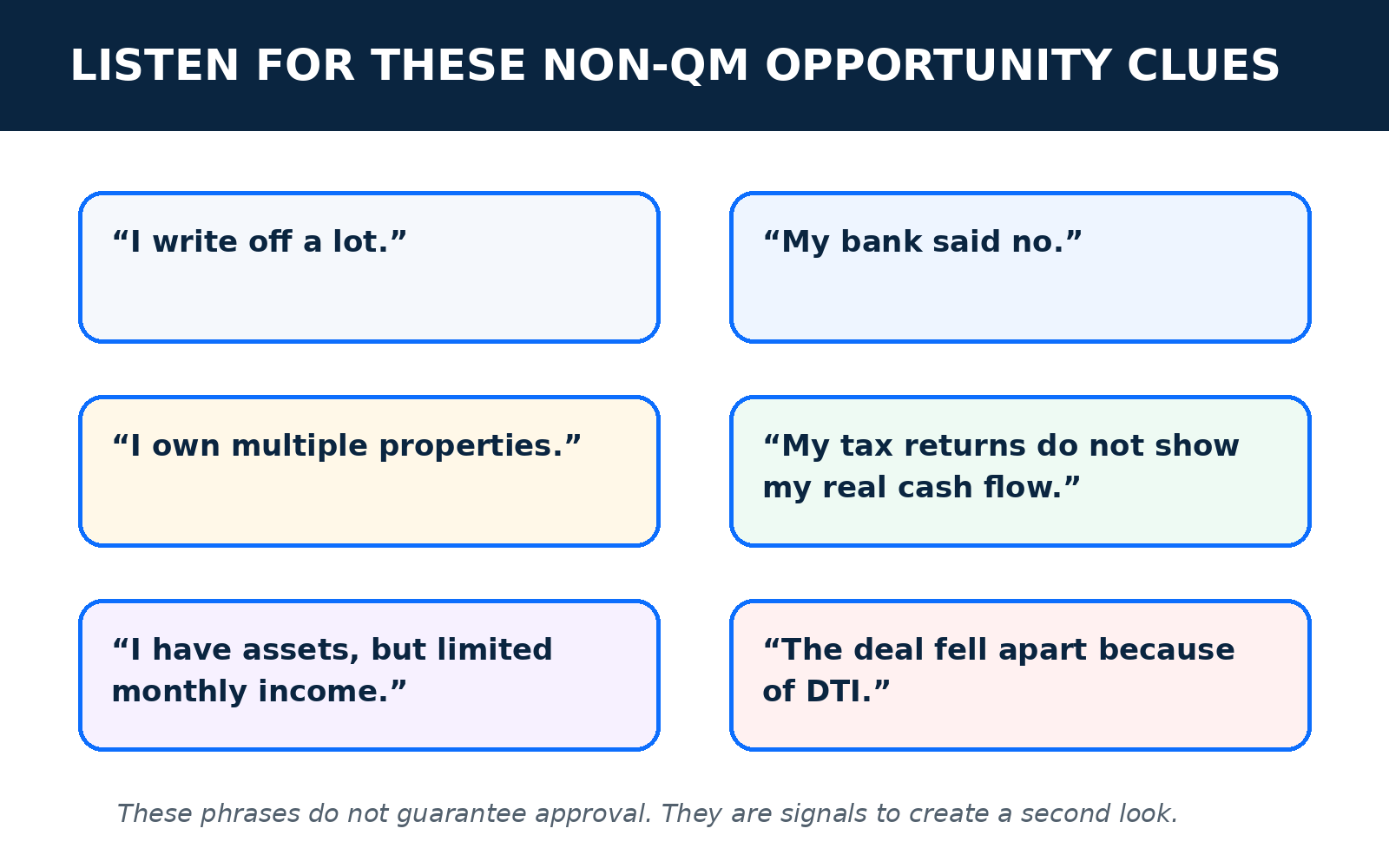
If your bank said no, your tax returns do not show your real cash flow, or you have substantial assets but limited traditional income, do not give up before receiving a thoughtful second look.
What to Gather for an Initial Conversation
You do not need to organize a complete underwriting package before calling. A productive first conversation usually begins with:
- Your estimated purchase price and desired down payment.
- How long you have been self-employed or receiving 1099 income.
- A general description of personal and business deposits.
- Whether tax returns reflect current business performance.
- Your estimated credit profile and major monthly obligations.
- Available cash, reserves, retirement funds, brokerage assets, or other investments.
- Whether the home will be a primary residence, second home, or investment property.
- Any previous lender decision and the reason provided.
From there, we can identify which documentation strategy deserves closer review and what would be required for a meaningful pre-approval.
Frequently Asked Questions
Can I qualify for a mortgage without using tax returns?
Possibly. Certain bank statement, P&L-only, 1099, DSCR, asset-utilization, and other non-QM programs may use alternative documentation. Eligibility and required supporting records vary significantly.
Are non-QM mortgages the same as no-documentation loans?
No. Non-QM lenders still underwrite the borrower or transaction according to program guidelines. The documentation method may be different, but the lender still evaluates credit, assets, income or cash flow when applicable, reserves, property eligibility, and the ability to repay when required.
Will a bank statement loan use every deposit as income?
No. Transfers, loan proceeds, refunds, one-time items, and other non-income deposits may need to be excluded. Business expense treatment also varies by lender and business type.
Does a DSCR loan require me to be self-employed?
No. DSCR loans are generally based on an eligible investment property's qualifying rental cash flow. They may be useful to salaried and self-employed investors alike.
Do I have to sell my investments for an asset-depletion mortgage?
Not necessarily. Some programs calculate qualifying income from eligible assets without requiring full liquidation. The lender's rules determine which assets count and how they are treated.
Do pledged assets remain mine?
Generally, the borrower retains ownership, but the assets are pledged as collateral and are subject to restrictions. The lender or custodian may limit withdrawals and require the portfolio to maintain a specified value.
Can I put only 10% cash down with pledged assets?
An eligible pledged-asset program may allow financing up to approximately 90% of the home's value in certain jumbo or portfolio scenarios, with approved investments pledged as additional collateral. The exact structure is highly specific. Call for a personalized review before relying on any particular percentage.
Let's Look at the Complete Financial Story
You worked hard to build your business, your income, and your assets. Your mortgage strategy should reflect the way you actually earn, invest, and plan for the future.
I will help you compare traditional and alternative mortgage options, understand the documentation, and decide whether there is a responsible path forward. Sometimes the answer is an immediate pre-approval. Sometimes it is a clear plan that puts you in a stronger position over the next few months. Either way, you deserve clarity rather than a quick dismissal.
Ready to Explore Your Mortgage Options?
Whether your income comes from a business, 1099 work, rental property, investments, or a combination of sources, I am here to help you determine the next responsible step.
You do not need to know which program fits before calling. We will begin with your goals and complete financial story.
Schedule a Conversation
Talk with Steve about your business, income, assets, purchase goals, and possible mortgage paths.
Start Pre-Approval
Begin securely online so we can evaluate your complete financial picture.
Call or Text
Prefer a direct conversation? Reach Steve using the appropriate number below.
Call:
844-522-7100
Text:
209-522-7100
Email: Steve@FirstCapitalMortgageInc.com
One Small Favor
If any of your friends, family, or co-workers are looking to buy, sell, or refinance, can I count on you to introduce us via text or email?
That introduction may help someone receive the thoughtful second review they need before giving up on homeownership.
Make it a Successful Week!
Steve McNeal
First Capital Mortgage Inc.
Additional Resources
- Self-Employed Home Loan Solutions for Business Owners and Independent Contractors
- The Non-QM Advantage: A Guide for Real Estate Agents
- Mortgage Home Purchase Loans Made Simple
- Consumer Financial Protection Bureau: Ability-to-Repay Rule
- Axos Bank: Portfolio and Pledged Asset Mortgage Options
Important: This article is for general educational purposes and is not tax, investment, legal, or accounting advice. It is not a commitment to lend, a guarantee of approval, or a quote of rates or terms. Mortgage programs, pricing, documentation, eligible assets, down payment, pledged-collateral requirements, reserve requirements, property eligibility, and underwriting standards vary by lender and borrower circumstances and may change without notice. All loans are subject to application, credit review, verification, appraisal when required, underwriting, and final approval. Consult your tax, legal, and investment professionals before making decisions involving the sale or pledge of investment assets. Equal Housing Opportunity.