

Price Reduction Alternatives | Protect the Listing Price
Price reduction alternatives deserve a closer look before a seller cuts the price of a market-supported home. Builders have understood this for years. Instead of automatically lowering the sales price, they often use financing incentives to address what is really stopping the buyer: the monthly payment, interest rate, or cash needed to close.
Listing agents can apply the same idea to resale homes.
The goal is not to defend an overpriced listing.
The goal is to protect a price that is supported by the market when the buyer’s real objection is affordability. In that situation, seller credits, closing-cost assistance, discount points, or a temporary mortgage buydown may create more useful value than another public price cut.
That distinction matters. If buyers are not showing up at all, the property may be overpriced, poorly presented, or incorrectly marketed. However, if buyers are touring the home and saying, “We like it, but the payment is too high,” the problem may be financing rather than value.
Price Reduction Alternatives: Why Builders Protect the Sales Price
Home builders rarely rely on price cuts alone. Instead, they often combine the sales price with incentives that improve affordability.
In August 2026, the National Association of Home Builders reported that 63% of builders were using sales incentives. By comparison, 35% were cutting home prices. Among builders that reduced prices, the average reported reduction was 6%.
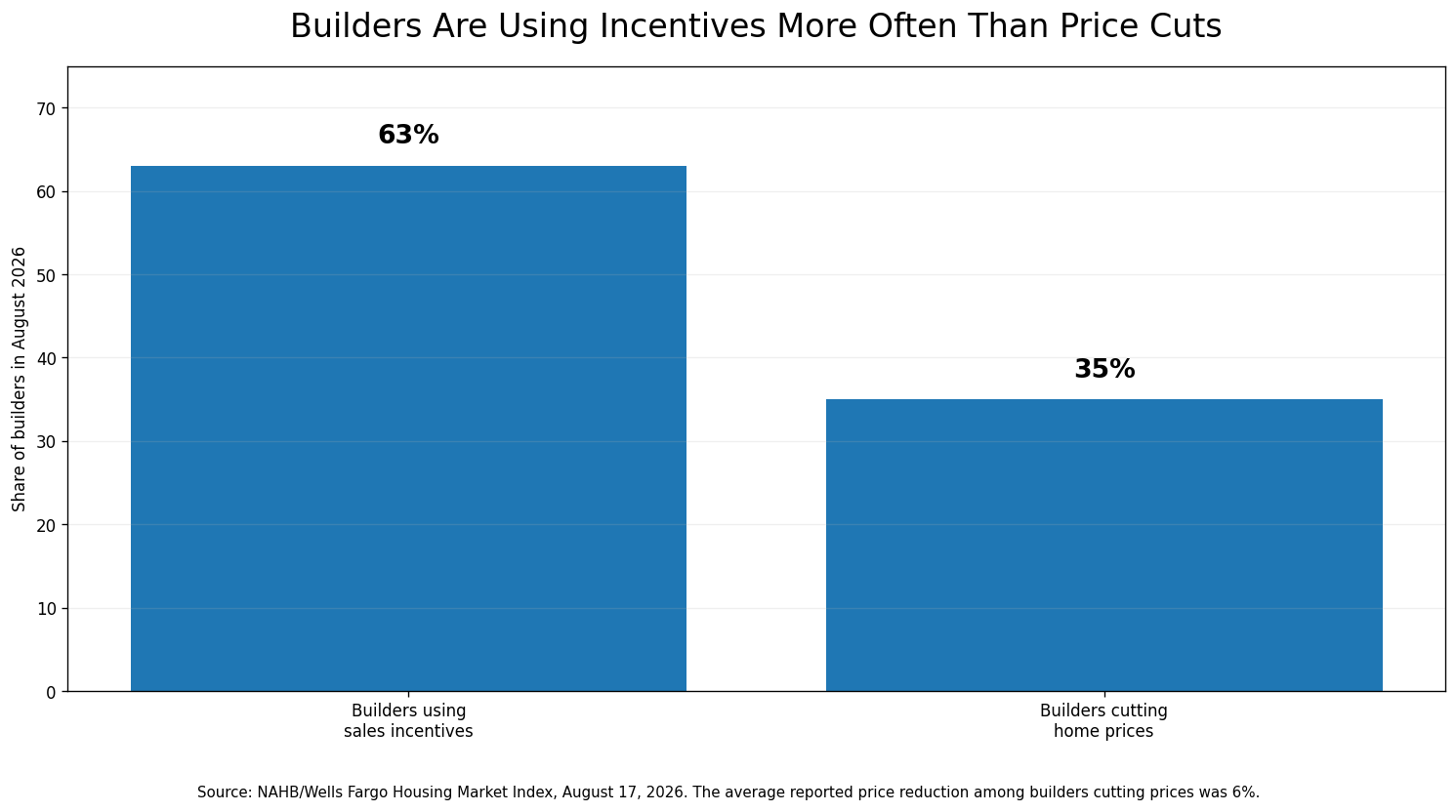
This approach is not limited to new construction. Redfin reported that sellers provided a concession in 46.2% of U.S. home sales during the three months ending May 2026. Those concessions included closing-cost assistance, repairs, and mortgage-rate buydowns.
of builders used sales incentives in August 2026
of resale sellers in Redfin’s May analysis gave a concession
Freddie Mac national 30-year fixed average on August 20, 2026
The reason is easy to understand. At a 6.65% mortgage rate, a buyer can love a house and still hesitate over the payment. That is where price reduction alternatives can become useful.
Before Cutting $15,000 From the Price, See What the Same $15,000 Can Do
Consider a simple example. Assume a home is listed at $500,000 and the price is supported by comparable sales.
The buyer plans to put 10% down and obtain a 30-year fixed mortgage at an illustrative 6.65% note rate.
- Purchase price: $500,000
- Down payment: $50,000
- Loan amount: $450,000
- Illustrative note rate: 6.65%
- Monthly principal and interest: approximately $2,889
Now assume the seller is willing to give up $15,000 to make an acceptable transaction work.
Option 1: Reduce the Price by $15,000
The sales price becomes $485,000. With the same 10% down structure, the loan amount drops to approximately $436,500.
Monthly principal and interest falls to about $2,802. That is a savings of approximately $87 per month.
The buyer would also need about $1,500 less for the down payment. Those are real benefits. Still, they may not solve the buyer’s actual objection.
Option 2: Keep the Supported Price and Use the Seller Dollars Strategically
Instead of cutting the price immediately, the seller could reserve up to $15,000 for allowable buyer financing and closing costs. The final use would depend on the buyer, loan program, appraisal, lender requirements, and contract terms.
One possible strategy is a seller-funded 2-1 temporary buydown.
In this example, the mortgage still has a 6.65% note rate. The buydown funds simply subsidize part of the required payment for the first two years.
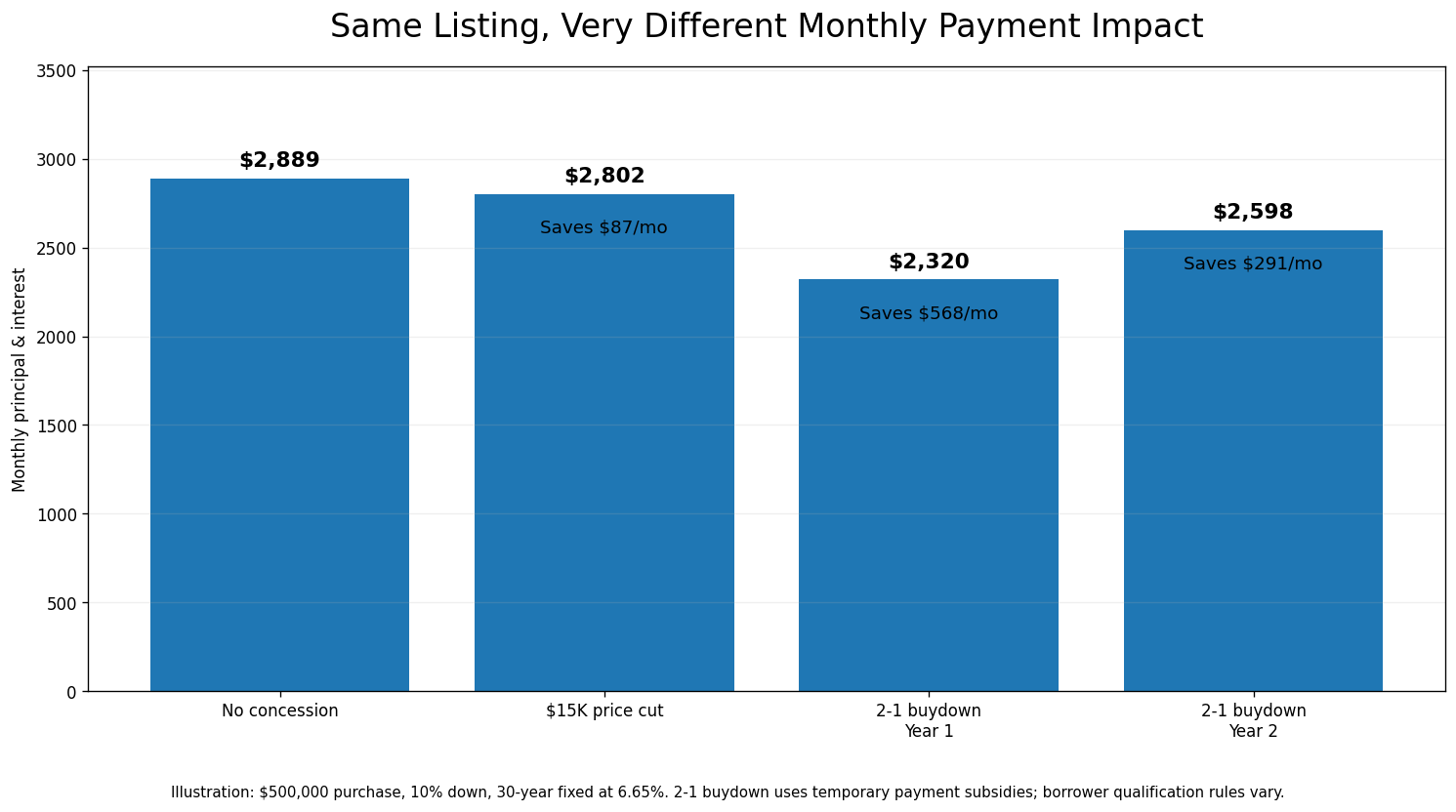
In this illustration, the 2-1 subsidy costs about $10,317. That leaves roughly $4,683 from the seller’s original $15,000 budget that may be available for other eligible costs.
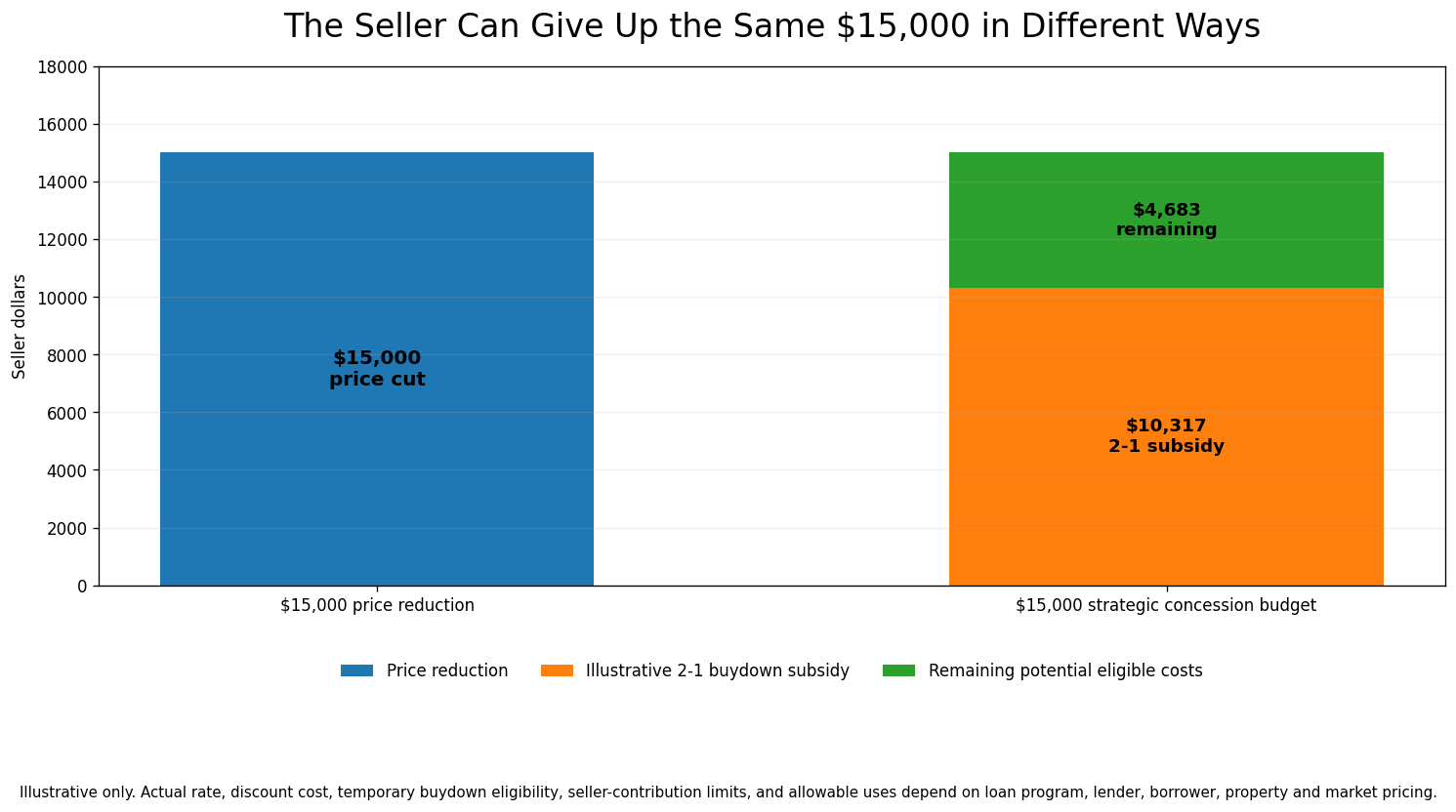
This does not mean a temporary buydown is automatically better than a price reduction. It means the same seller dollars can solve different problems.
Different Buyers Need Different Price Reduction Alternatives
The best use of seller dollars depends on the buyer’s situation.
Buyer A: Cash Is the Problem
This buyer may have enough income to qualify but does not want to spend every available dollar at closing. Seller-paid closing costs or prepaid items may provide more practical value than a modest price reduction.
Buyer B: Monthly Payment Is the Problem
This buyer may have enough cash but feels uncomfortable with the monthly payment. A permanent rate buydown or temporary buydown may deserve consideration.
Buyer C: Long-Term Cost Matters Most
This buyer plans to stay in the home for many years. If the pricing works, a permanent interest-rate reduction may be more attractive than a temporary subsidy.
Buyer D: The Price Really Is the Problem
Sometimes the cleanest answer is still a lower price. If the market does not support the current value, financing incentives should not be used to hide that reality.
That is why the decision should begin with analysis, not with a preset sales tactic.
The Four-Step Builder Strategy for Listing Agents
1. Diagnose the Real Objection
First, look at the feedback.
If the home is receiving very few showings, the listing may need a pricing or marketing adjustment.
If buyers are showing up but not writing offers, ask why. Payment, cash-to-close, and interest rates may be the real barrier.
2. Create a Seller Negotiation Budget
Before reducing the price by another $10,000, $15,000, or $20,000, ask the seller what amount they would be willing to use to make the right transaction work.
That amount becomes a negotiation budget. It does not need to be promised to every buyer.
For example, the seller might consider up to $15,000 toward eligible buyer financing or closing costs with an acceptable offer.
3. Model the Financing Before the Seller Cuts the Price
This is where an experienced mortgage professional can help the listing agent.
Before changing the price, compare several price reduction alternatives:
- an actual price reduction;
- allowable buyer closing-cost assistance;
- discount points for a permanent rate reduction;
- a temporary mortgage buydown when permitted;
- different down-payment structures;
- FHA, VA, USDA, or conventional financing when appropriate; and
- other programs that fit the borrower and property.
Then compare three numbers:
- What does the seller net?
- What does the buyer need at closing?
- What does the buyer pay each month?
Those numbers tell a much more complete story than a price reduction alone.
4. Market the Opportunity Carefully
Once the seller has approved the strategy, the listing can highlight possible seller assistance without promising a specific mortgage rate or payment to every buyer.
Example MLS concept:
Seller may consider a credit toward eligible buyer closing costs and/or financing costs with an acceptable offer, subject to loan program, lender, appraisal, and contract requirements.
If the advertisement includes a specific rate, payment, APR, down payment, or other credit term, additional disclosures may apply. A mortgage professional should provide compliant financing language before the promotion is published.
Price Reduction Alternatives Still Have Program Limits
Seller contributions are not unlimited. The maximum amount and allowable uses depend on the mortgage program, occupancy, loan-to-value ratio, actual closing costs, and other factors.
| Loan type | General framework |
|---|---|
| Conventional | For Fannie Mae loans on a principal residence or second home, maximum financing concessions are generally 3% when LTV/CLTV is above 90%, 6% from 75.01% through 90%, and 9% at 75% or less. Investment properties are generally limited to 2%. |
| FHA | FHA generally permits interested parties to contribute up to 6% of the sales price toward allowable closing costs, prepaid items, discount points, and permitted buydowns. Contributions cannot replace the borrower’s required minimum investment. |
| VA | VA has a 4% limit on items it defines as seller concessions. Ordinary closing costs and normal discount points are treated differently, so a simple “VA is capped at 4%” statement can be misleading. |
| USDA Guaranteed | Seller and other interested-party contributions are generally limited to 6% of the sales price and must be used for eligible loan purposes. |
These summaries are educational only. Agency, investor, and lender requirements can change. Always verify the current rule for the specific transaction before writing the offer or advertising the concession.
What About the Appraisal?
Seller concessions do not make appraisal issues disappear.
Financing concessions must be disclosed. The appraiser and lender may also analyze whether those concessions affected the contract price.
The strategy works best when the price is already supported.
If comparable sales do not support the listing price, mortgage incentives are not a substitute for proper pricing. However, when the value is supported and affordability is the real obstacle, price reduction alternatives may help the seller solve the correct problem.
Temporary Buydowns Do Not Replace Qualification
A temporary buydown can improve the buyer’s payment during the first one or two years. However, borrowers generally still must qualify using the full note-rate payment or the applicable agency underwriting calculation.
That makes a temporary buydown primarily a cash-flow strategy. It should not be presented as a way to qualify a borrower who otherwise does not meet normal underwriting requirements.
Before Your Seller Reduces the Price, Let’s Run the Numbers
Listing agents do not need to become mortgage underwriters to use this strategy.
You only need to recognize when financing may be part of the problem.
If your seller is considering a price reduction, send me:
- the current listing price;
- the reduction being considered;
- the property address;
- the type of buyer you are trying to attract; and
- the feedback you are hearing about payment, rate, or cash needed to close.
I can model several price reduction alternatives and compare what the same seller dollars may do as a price cut, closing-cost credit, permanent rate buydown, or temporary buydown.
That gives the agent and seller useful information before changing the public price.
Let’s Review the Listing Before the Next Price Reduction
If a listing is getting attention but not converting into offers, I would be glad to help model the financing side. A few minutes of analysis may reveal another way to create buyer value while protecting the seller’s objectives.
Choose a time with Steve
844-522-7100
Frequently Asked Questions
What are the best price reduction alternatives for a home seller?
Common options include seller-paid closing costs, discount points, temporary mortgage buydowns, and other allowable financing incentives. The best choice depends on the buyer’s needs, the seller’s net, the loan program, and whether the property’s price is supported by the market.
Are seller concessions better than a price reduction?
Not always. A price reduction may be the correct answer when the property is overpriced. When payment or cash-to-close is the buyer’s primary concern, an allowable seller concession may create more immediate value.
Can a seller pay for a mortgage-rate buydown?
Often yes, subject to the loan program, lender requirements, appraisal, seller-contribution limits, and actual transaction costs. Temporary and permanent buydowns are treated differently.
Does a 2-1 buydown change the mortgage note rate?
No. In a standard temporary 2-1 buydown, the note rate stays the same. Funds in the buydown account subsidize part of the required payment for the first two years.
Can a temporary buydown help a buyer qualify?
Borrowers generally must qualify using the full note-rate payment or the applicable agency underwriting calculation. A temporary buydown is mainly a short-term cash-flow tool.
Do seller concessions affect the appraisal?
They can. Financing concessions must be disclosed, and the appraiser and lender may analyze whether they influenced the sales price.
Related Reading
This strategy builds on a lesson we previously covered in our article about how builders use mortgage incentives to protect pricing.
Sources
- Freddie Mac, Primary Mortgage Market Survey, August 20, 2026: https://www.freddiemac.com/pmms
- National Association of Home Builders, “Affordability Pressures Keep Builder Confidence Low,” August 17, 2026: https://www.nahb.org/news-and-economics/press-releases/2026/08/affordability-pressures-keep-builder-confidence-low
- Redfin, “46% of Home Sellers Gave Concessions to Buyers in May,” June 22, 2026: https://www.redfin.com/news/home-seller-concessions-record-high-rate/
- Fannie Mae Selling Guide B3-4.1-02, Interested Party Contributions: https://selling-guide.fanniemae.com/sel/b3-4.1-02/interested-party-contributions-ipcs
- Freddie Mac Loan Product Advisor Documentation Matrix, Financing Concessions: https://sf.freddiemac.com/docs/pdf/update/docmatrix.pdf
- U.S. Department of Veterans Affairs, VA Funding Fee and Loan Closing Costs: https://www.benefits.va.gov/HOMELOANS/purchaseco_loan_fee.asp
- USDA Rural Development, Single Family Housing Guaranteed Loan Program FAQs: https://www.rd.usda.gov/sites/default/files/rd-sfh-faqloanorigination.pdf
- HUD, FHA Single Family Housing Policy Handbook 4000.1: https://www.hud.gov/hud-partners/single-family-handbook-4000-1
Educational disclosure: Mortgage rates, pricing, loan programs, seller contribution limits, and underwriting requirements change and may vary by borrower, property, occupancy, lender, and market conditions. Examples are for educational purposes only and are not a commitment to lend, a rate quote, or a guarantee of approval or savings. Buyers and sellers should review their actual transaction with their licensed real estate and mortgage professionals.